The True Conqueror (A Theological-Religious Study)
“Constantinople shall surely be conquered. Whoever conquers it will become the best commander, and the army that conquers it will be the best army,” — as reported by the Prophet Muhammad.
This hadith is recorded in numerous sources and is widely recognized as authentic. In this study, we will not examine the chain of transmission in detail, as the hadith belongs to the category of sahih and its authenticity is generally accepted. The primary focus will be on the semantic and historical-contextual analysis of the hadith, since misinterpretations of this text over history have led to various erroneous understandings. It should be noted that the hadith is recorded in both Sunni and Shia sources.
It is well known that during the early period of Islam’s mass propagation, the Prophet Muhammad sent letters inviting the rulers of major states to embrace Islam, including those of Egypt, Ethiopia, the Sasanian Empire, Bahrain, and the Byzantine (Eastern Roman) Empire. Full texts of these letters have been preserved in historical sources and are available for study.
This research focuses on the Eastern Roman Empire, as the hadith directly pertains to its capital, Constantinople. Military engagements between the early Islamic Caliphate and Byzantium began during the Prophet’s lifetime. The first major battle, known as the Battle of Mu’tah, ended in a severe defeat for the Muslims. The second military expedition, to Tabuk, did not result in combat, and the army returned under the Prophet’s leadership without fighting.
In the final years of his life, while ill, the Prophet instructed Usama ibn Zayd to assemble an army for a third expedition against Byzantium at the borders of Medina. However, for various reasons, the Muslims did not reach the designated camp, causing deep concern for the Prophet, which he openly expressed. As a result, the Muslims did not achieve a decisive victory over Byzantium, which was of great significance to the Prophet, and he passed away without witnessing it.
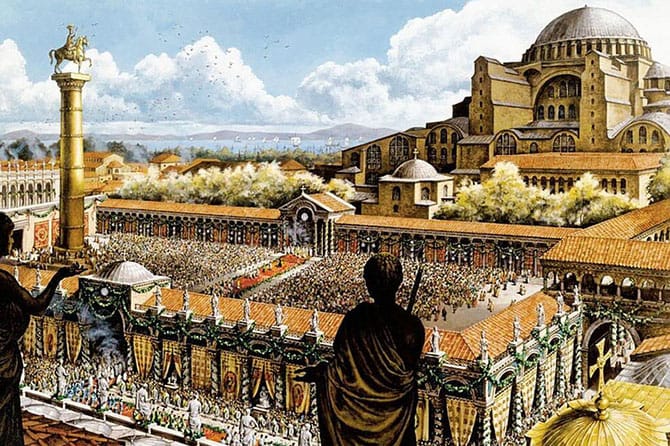
Analysis of the hadith and historical events shows that the Prophet attached particular importance to the conquest of the Eastern Roman Empire, especially its capital, Constantinople. Later, Muslim armies won a series of victories against Byzantium, but the complete conquest of Constantinople under the Caliphs never occurred; armies reached the city walls but could not capture it. Only in the 15th century did Sultan Mehmed II of the Ottoman Empire finally conquer Constantinople, earning the title Fatih (the Conqueror). According to the hadith, Mehmed the Conqueror was recognized as the “best commander,” and his army as the “best army.”
It should be emphasized that the hadith and the importance of Byzantium (the Eastern Roman Empire) as stressed by the Prophet undoubtedly motivated Muslims to participate in military campaigns. It is reported that Mehmed the Conqueror himself drew inspiration from this hadith.
However, a key question arises: why did the Prophet place such importance on Byzantium, and what did he truly mean?
A deeper analysis indicates that the reference was not about a specific territory or military conquest. By that time, the Islamic Caliphate had already been consolidated; the Hijaz was fully Islamized, the Muslim community had strengthened, and Byzantium was not actively hostile toward Muslims. Therefore, the true significance of “importance” regarding Byzantium was symbolic and strategic: the new Muslims could not fully comprehend future global developments, and religious guidance was presented according to their level of understanding. In Islam, knowledge and comprehension are of paramount importance; according to religious sources, on the Day of Judgment, a person will be questioned according to the level of their understanding.
The issue of Byzantium is also mentioned in the Qur’an; there is even a sura entitled Ar-Rum (The Romans). In my view, this hadith explains precisely the reference contained in the Qur’an. Logical analysis confirms that the Prophet was not speaking of territorial conquests. Muslims mistakenly interpreted the hadith in a literal, territorial sense. The Sasanian Empire, territorially more significant and threatening to the Caliphate, does not have a comparable hadith regarding its conquest.
In fact, the term Constantinople in the hadith does not denote a specific city and is not confined to the Prophet’s lifetime. It symbolizes the West as a whole—Europe, which would eventually become the center of global civilization. At that time, the most recognizable city capable of symbolizing Europe was Constantinople.
Thus, the Prophet points to the long-term destiny of the world: a time will come when the center of global civilization will be in Europe, and its “conquest”—that is, the spread of Islam—will become the greatest event. Historically, since the Renaissance, Europe freed itself from ecclesiastical dominance and achieved outstanding progress in all areas of life, becoming the global center of influence. Since then, Europe has been the main target for world powers. Whoever establishes influence in Europe effectively governs the world.
In the context of the hadith, the term “conquest” should be understood not merely as military action but as the spread of Islam among European peoples. The hadith points to a future savior of the world who will establish global rule of justice—the Imam Mahdi. His authority, extending to Europe, will be global and final.
Signs of this process are observable today: the spread of Islam in Europe, mass migration of Muslims, the growing interest of Europeans in Islam, and spiritual trends within postmodern movements. These processes will culminate under the just governance of the Imam Mahdi.
Information about Imam Mahdi and Mahdism is found in both Sunni and Shia sources. Overall, the concept of the “Great Return” is anticipated by all divine religions. The hadith alludes to this: the “best commander” and his “best army” refer to Imam Mahdi and his followers.
It should be emphasized that this interpretation does not diminish the achievements of Mehmed the Conqueror in capturing Constantinople. He and his army made significant contributions to the spread of Islam. We merely highlight that the hadith carries a profound symbolic meaning, relating to Imam Mahdi and his future mission.
Namig Babakhanov (Theologian)
Baku, April 2025